
Employees appreciate opportunities that allow them to reduce hefty medical expenses. When you provide them with the means to save more money through comprehensive health benefits or other special perks, you strengthen their financial wellness. This can actively drive high retention and employee satisfaction for your organization.
A health reimbursement arrangement (HRA) or a flexible spending account (FSA) is a great employee perk that can help increase savings. HRAs and FSAs are not only cost-efficient, but also provide tax-free advantages for both employers and employees.
In this article, we’ll compare the notable differences between an HRA and FSA to help you better understand the benefits of each—and determine which one might be the best choice for your company.
Health Reimbursement Arrangement
An HRA is an employer-funded benefits plan that allows employees to save pre-tax dollars on certain qualified medical, pharmacy, or dental expenses. In other words, employees receive tax-free reimbursements for their medical costs, and employers are then eligible to take tax deductions on those reimbursements.
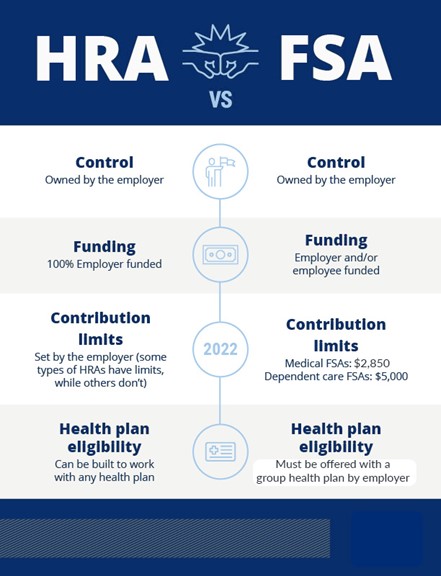
On an annual or monthly basis, employers determine the set amount that they’ll put into their employees’ HRA. Some employees may receive a bit more, depending on their age or number of dependents. This money is tax-deductible for employers.
Employers can also customize their employees’ HRAs to work with any health plan. They have the power to set their own contribution limits, determine eligibility for qualified medical expenses, and decide whether an HRA will roll over every year.
With First American Bank Health Account Services, you have complete control over your HRA design. This means that you get to set individual goals for your employees, and create a plan that adequately covers their medical costs.
Flexible Spending Account
An FSA is another employer-funded account that allows employees to set aside pre-taxed savings to cover various eligible medical expenses.
Employees who are enrolled in a medical FSA may also enroll in some types of HRAs. Similar to an HRA, a flexible spending account is employer-owned. However, employees can contribute a certain amount of their own money to their FSA through payroll deductions, while only employers can contribute to an HRA.
By contributing to an FSA, employees reduce their taxable income. As an employer, you won’t need to pay Social Security or Medicare tax on the funds they contribute to an FSA. There are three types of FSAs that can be offered by an employer:
- Health FSA
- Dependent Care FSA
- Limited Purpose FSA
FSAs and HRAs are both employer-funded, but the key difference is that employees can choose how much they want to contribute to an FSA, while you determine the amount you put in employee HRAs. FSAs save you money by reducing your employee’s taxable income. On the other hand, HRAs allow you tax breaks for your employer contributions.
Although FSAs and HRAs both have their benefits, knowing the details of each type of account can help you decide which plan is most beneficial for your employees. With the assistance of a First American Bank Health Account Services advisor, you can choose and customize a benefits plan that best meets your employees’ needs while saving you money and optimizing your tax strategy.
Want to learn more about the consumer-driven health benefit products we offer? Contact First American Bank's Health Account Services team at (847) 586-2239 or email [email protected].