As a business owner, providing a Flexible Spending Account (FSA) to your employees may be a key part of your benefits package. But it also means you bear the responsibility of ensuring that employees properly substantiate their claims. If not, you could be liable for tax fraud or other financial headaches that may follow. That’s why it's extremely helpful to have an FSA administrator who can simplify the substantiation process for your employees.
Here’s why IRS substantiation guidelines are important, and what steps you and your employees can take to stay in compliance.
Why is substantiation required?
Because FSAs offer tax advantages to both employers and employees, the IRS requires proof that FSA funds are only being spent on eligible healthcare expenses.
Incorporating FSAs into your benefits package is a great move, as they offer an efficient way to put aside pre-tax dollars to be used toward out-of-pocket healthcare expenses. When employees participate in an FSA, you save on FICA taxes since their participation reduces their taxable wages. Additionally, the funds they contribute and their reimbursements for eligible healthcare expenses are not taxed.
How do substantiation requirements affect you and your employees?
As a business owner, you have a responsibility to your employees to follow regulation requirements. Because FSAs are employer-sponsored accounts, it’s particularly important for you to comply with IRS regulations and provide the appropriate documentation to stay in compliance. If the IRS determines your FSA is or was not in compliance with the substantiation requirements, your FSA could become disqualified. In some circumstances, the IRS could treat all medical FSA reimbursements, including those that were properly substantiated, as taxable wages and therefore subject to FICA and FUTA taxes.
What does the IRS require for FSA substantiation?
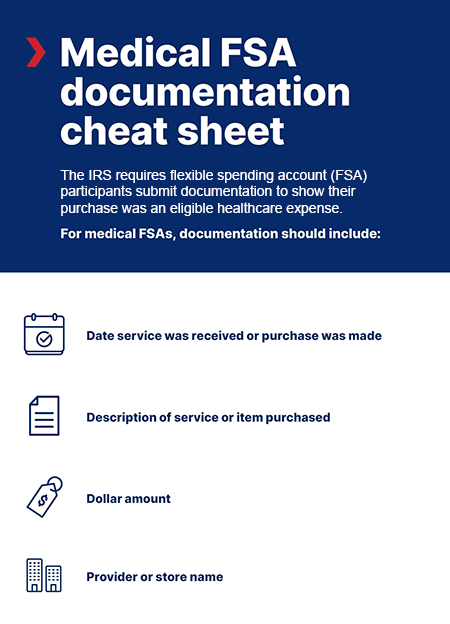
In order to reduce your risk as an employer and eliminate financial headaches, it’s important to choose a third-party administrator to help substantiate claims. Though IRS regulations outline employee documentation, an FSA administrator like the ones at First American Bank will ensure that all claims are properly substantiated and submitted. For medical FSAs, documentation should include:
-
Date service was received, or purchase was made
-
Description of service or item purchased
-
Dollar amount
-
Provider or store name
An Explanation of Benefits (EOB) typically contains the information required by the IRS.
How First American Bank can simplify substantiation
First American Bank supports you and your employees throughout the entire substantiation process. By opening an FSA through First American Bank Health Account Services, your employees will have access to an easy-to-use online platform, technical support, and educational materials to make it easier for them to access their funds and understand their options.
Additionally, our Health Account Services benefits debit card automatically approves any FSA purchases on eligible healthcare expenses when used at merchants with an Inventory Information Approval System (IIAS). That’s why, on average, participants with a First American Bank Health Account Services benefits debit card see 85% of their debit card purchases automatically approved without additional documentation. And in situations where more documentation is required, employees can easily upload paperwork via the FAB Health mobile app from the Apple App Store or Google Play, or through their online accounts.
Interested in learning more about FSA substantiation for your company? The below FSA documentation cheat sheet will help you get started.